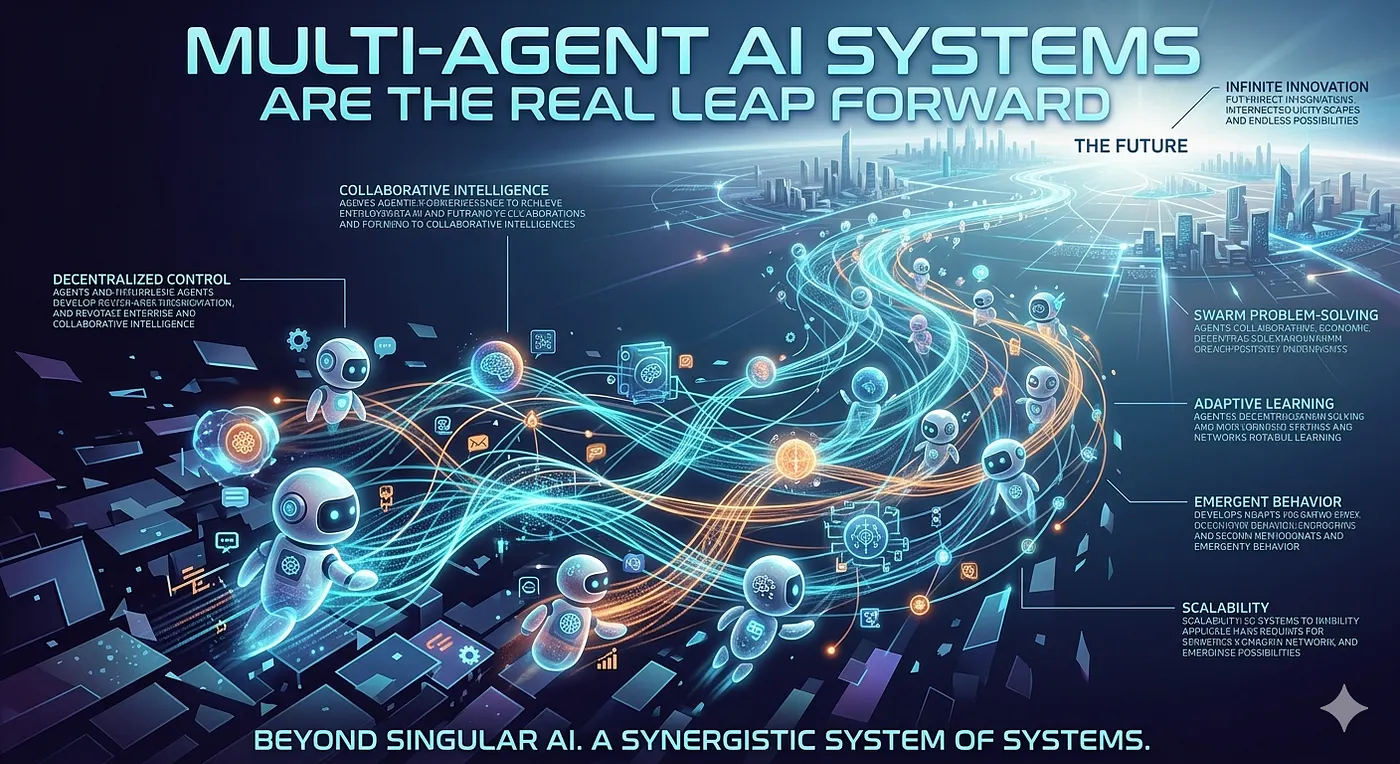
Single AI models are impressive until they aren’t. Ask one to write, test, and deploy code in a single go, and you’ll often end up with something that looks confident but falls apart under scrutiny. The model loses the thread. It hallucinates. It ships bugs.
That’s not a knock on the technology; it’s just the nature of asking one thing to do everything.
The more interesting shift happening right now isn’t about making individual models smarter. It’s about making them work together. Multi-agent systems where specialized AI agents each handle a distinct piece of a workflow are changing what’s actually possible with automation.
Why Specialization Makes Sense
Think about how good software actually gets built. Not by one person doing everything, but by a team where each person has a lane: the developer focused on implementation, the reviewer catching edge cases, the QA engineer hammering the thing until it breaks.
Multi-agent AI borrows the same logic. Instead of overloading one model, you split the work:
- The Coder: handles logic, syntax, implementation. That’s it.
- The Reviewer: looks for security holes, style violations, anything that shouldn’t ship.
- The Tester: writes unit tests, runs them, flags what fails.
Each agent is tuned for its role. The result is more precise output than any single “do-everything” model can reliably produce.
The Two Frameworks Worth Knowing
Getting agents to work together requires an orchestration layer. Two frameworks dominate right now, and they take meaningfully different approaches:
CrewAI works best when your workflow is sequential and predictable: task A feeds task B feeds task C. It’s role-based and process-driven. If you can map your pipeline in a straight line, CrewAI handles it cleanly.
LangGraph is built for messier, more realistic workflows. Real engineering isn’t linear: you write code, a test fails, you go back and fix it, you run the test again. LangGraph supports those loops natively. Agents can cycle back based on conditions (like “keep trying until the test suite passes”), which is what makes genuine autonomy possible.
The Self-Healing Loop in Practice
The key concept in LangGraph is shared state, a common memory that every agent reads from and writes to. One agent’s output becomes the next agent’s input, including errors, history, and context.
Here’s a stripped-down version of what a self-healing coding loop looks like:
from typing import TypedDict, List
from langgraph.graph import StateGraph, END

# Shared memory across agents
class AgentState(TypedDict):
    code: str
    errors: List[str]
    iterations: int

def programmer_agent(state: AgentState):
    print("--- PROGRAMMER: Writing/Fixing Code ---")
    return {"code": "def hello_world(): return 'Hello World'", "iterations": state['iterations'] + 1}

def test_engineer_agent(state: AgentState):
    print("--- TESTER: Validating Execution ---")
    if "Hello World" in state['code']:
        return {"errors": []}
    return {"errors": ["Output does not match requirements"]}

workflow = StateGraph(AgentState)
workflow.add_node("programmer", programmer_agent)
workflow.add_node("tester", test_engineer_agent)

workflow.set_entry_point("programmer")
workflow.add_edge("programmer", "tester")

# Loop back if there are errors, up to 3 attempts
workflow.add_conditional_edges(
    "tester",
    lambda state: "programmer" if state["errors"] and state["iterations"] < 3 else END
)

app = workflow.compile()
What this really means is that the system can catch its own mistakes and correct them without a human stepping in. The loop runs until the code either passes or hits the retry limit.
Why Enterprises Should Care
There’s a growing tension in how companies use AI: the more critical the task, the more humans feel they need to stay in the loop, but that defeats the efficiency gains. Manual review becomes the bottleneck.
Multi-agent systems start to resolve that. For repetitive, high-frequency tasks (API monitoring, automated documentation, routine code maintenance) these systems can operate independently with a level of reliability that single-model chatbots simply can’t offer.
The distinction worth making here is that this isn’t about AI moving faster. It’s about AI being trustworthy enough to actually finish the job. That’s a different bar, and multi-agent architectures are one of the more credible paths to clearing it.